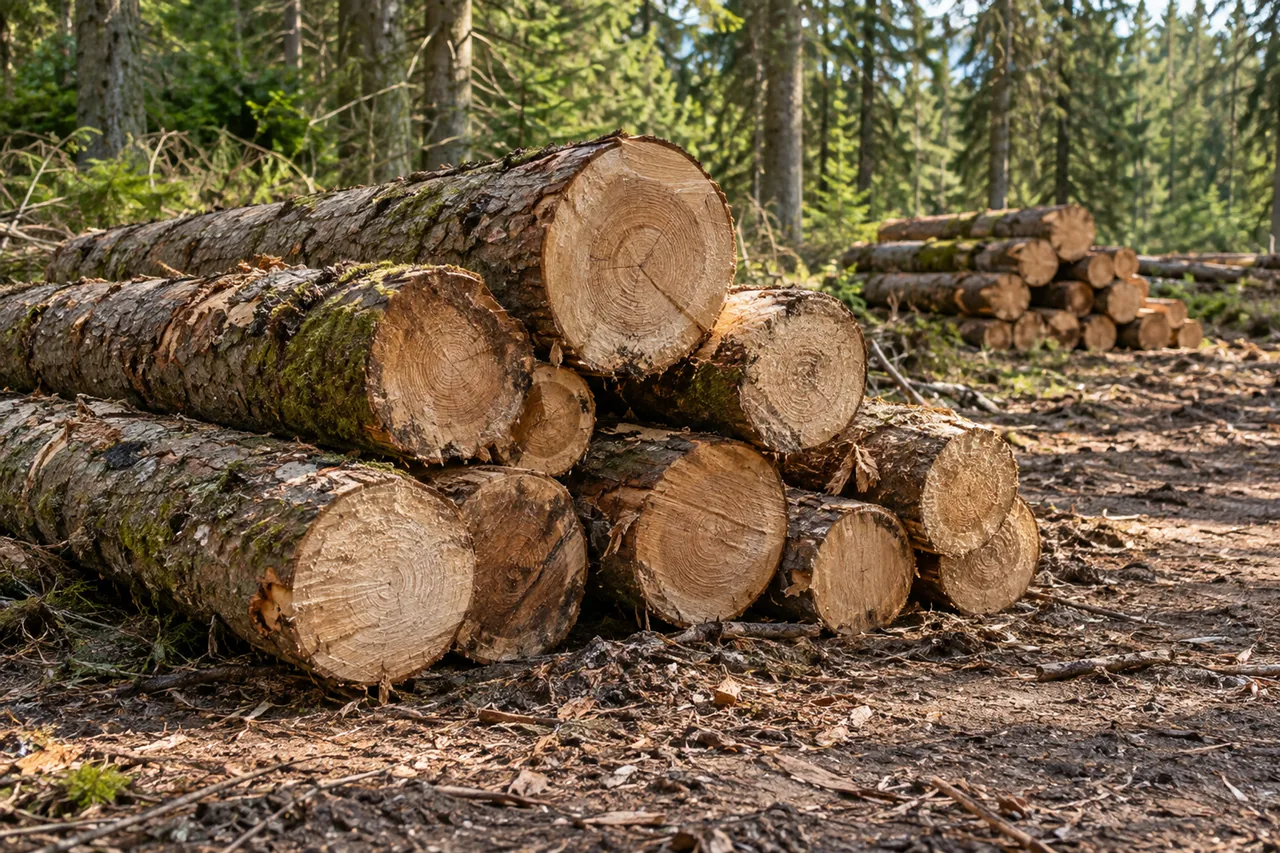
Timber, from the plot to the sawn board.
Record logs by plot with their species, keep sawing, drying and planing linked to every input, and hand on each lot with its certificates and the EUDR evidence.
In figures
- 22EUDR Annex I codes for wood and rubberCounted in the platform’s EUDR scope.
- 8EUDR controls, forest loss after 2020 among themCounted in the EUDR control pack.
- 1.1 sEUDR evidence pack, built and signedMedian of 75 signed packs, queue time not counted.
Counted in the platform’s code or measured on the A-REX test environment, November 2026. Not customer results.
The challenge
Wood changes form and unit at every step, and the plots behind it are often large.
Logs, boards, chips
Felling, sawing and drying each change the product, and cubic metres of logs become boards and by-products.
Large plots need a polygon
A plot over 4 hectares recorded as a single point is flagged where a polygon is needed.
Wood is in the EUDR
Buyers in the EU ask for plot geolocation, the production period, the species and the statement reference.

Products used
How A-REX runs timber, step by step.
01
Journey
Follow boards back through the sawmill to the plots the logs came from, on one map. Each place says how it is known: recorded on the ledger, declared, or a party's default site.
- From the plot to the sawmill and the port, on one map
- Recorded, declared or default site, place by place
Fictitious demo data 02
Lineage
Each board names the logs it was sawn from, each lot in its own unit. Follow a lot back to the plots, or forward to every holder of lots made from it, even across companies.
- Logs to boards, inputs kept
- Each lot in its base unit, nothing rounded unsaid
Fictitious demo data 03
Evidence checks
Wood falls under the EUDR. The evidence check shows for each lot what is recorded, missing or not verifiable here, and a plot over 4 hectares kept as a single point is flagged where a polygon is needed.
- Each EUDR requirement, gaps first
- Large plots flagged where a polygon is needed
Fictitious demo data 04
Network
Plot geolocation can identify a landholder. A supplier shares plots under a statement confirmed with a second factor, and the customer sees coordinates, never the farm's name. Other evidence is shared item by item.
- Plots shared under a confirmed statement
- Customers see coordinates, never the farm's name
Fictitious demo data 05
Tracked deliveries
Deliver logs to the sawmill or boards to a buyer, checked by your lot rules first. The custody record keeps each step signed, and the route shows as recorded up to the last position; the rest reads as not measured.
- Lot rules checked before the truck leaves
- The route recorded up to the last position
Fictitious demo data 06
Signed audit pack
The shipment pack puts the EUDR evidence of a timber delivery in one signed file, with the plots as GeoJSON for the EU Information System. Buyers check a copy without an account.
- Plots, certificates and statement reference in one file
- Checked without an account or trust in A-REX
Fictitious demo data



The journey, stage by stage
Every step is a proposal a person approves.
Register logs by plot
Plots kept as points or polygons, encrypted and off the public record, each lot with its species.
Scale them at the log yard
Logs are received and measured in cubic metres; each lot keeps the plot it came from.
Saw, dry and plane, keeping the inputs
Each new lot of boards names the logs it was sawn from, and by-products such as chips get lots of their own.
Share plots with your customer
Under a statement confirmed with a second factor; the customer sees coordinates, never the farm's name.
The evidence it produces
What a buyer, an auditor or a verifier you allow can read, with who declared each part.
- Lineage
- Each lot back to its inputs and their plots or farms, and forward to every holder.
- Plots and production dates
- Plots as points or polygons, and production dates set against the 31 December 2020 cut-off.
- Certificates and lab results
- Each with its issuer, its validity and its evidence level.
- The statement reference
- The due diligence statement reference on each delivery under the EUDR.
- EUDR evidence check
- Requirement by requirement: evidence recorded, missing, not verifiable here, gaps first.
- Signed shipment pack
- A signed document, with GeoJSON for the plots, that anyone can verify without an account.
An evidence check lists what the records hold. It is not a legal opinion and never says that a lot complies.
Regulation crosswalk
What each rule asks of you, and where the platform keeps it. Evidence, not a legal opinion.
| Rule | What it asks of you | Where the platform keeps it |
|---|---|---|
| EUDR | Plot geolocation, the 31 December 2020 cut-off and the due diligence statement reference. | Plots as points or polygons, harvest dates against the cut-off, the statement reference on each delivery, what is missing, and the statement prepared for TRACES. |
| Certification schemes | Organic and other schemes, as certificates a lot must carry. | Each certificate with its issuer and evidence level; a lot rule can stop a lot that lacks one. |

Talk to us about Timber
Tell us where your wood comes from and how it is sawn. We will set it up with your products and units.
Talk to us